
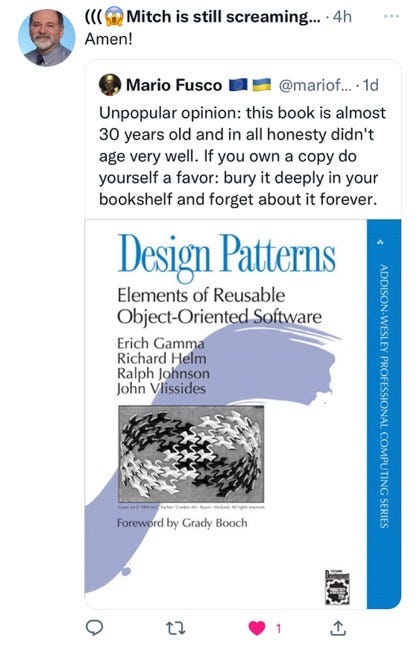
After 30 years, people are finally celebrating the demise of Design Patterns. This book was once a classic on every shelf of Google. When I first read this book more than a decade ago, I found it to be complete nonsense, but I didn’t expect it to be such a scourge that it would take so many years of unremitting struggle for brilliant programmers to start turning things around. With so many smart people in the world, why do they need to do something like this? Nearly 10 years of my book Demystifying Design Patterns.
How did the stupid concept put forward by the bad book GOF “Design Patterns” become popular, how did it occupy every bookshelf of companies like Google, and even become a common test question in job interviews for many companies, causing many people to have to learn it? This matter is extremely frightening, because it seems to hide a very clever mind control technology behind it, similar to a cult.
It’s not just functional language programmers who hate design patterns, but traditional C, C++ programmers also hate it. Design patterns seriously hinder programmers’ simple and normal thinking, creating layers of meaningless “abstraction” and “reuse”, and finally there are few lines of code doing real things, and no one can really understand and reuse this code. In fact, most functional programmers, advanced C programmers, are much better than programmers who have learned design patterns, and even easily surpass the four authors of GOF Design Patterns. It is impossible for these programmers to accept design patterns.
In the earliest days, everyone used C language, using an object-oriented language such as C++, in fact, there was no concept of design patterns, and people used traditional computer terminology to communicate with each other, and there was no problem at all. The book “Design Patterns” suddenly came out, providing people with a new, overly complex, meaningless set of “pattern language” to express concepts that they could simply express, and finally led to people having to use the language they designed to communicate, passed down from generation to generation, and then it was difficult to escape their control.
If the bookshelf is Knuth’s TAOCP, although no one really reads it, it makes sense. At least Knuth himself can write very clever programs, his books are not understood, and there is no harm in placing them as decorations. If you haven’t heard of Dan Friedman, Kent Dybvig, learning Dennis Ritchie, Linus Torvalds, and looking at the text and code they write, I don’t have such a big opinion, because they at least really wrote brilliant code with world-class impact. However, some companies have Design Patterns on every shelf, which is very harmful. I think this book should be treated as a cult doctrine.
A few authors who have never heard of names before, have unknown origins, do not have deep academic backgrounds, do not have hand-held industrial achievements, do not have clever open source code, and the books written are like student papers that will be sent back to be redone, which can only be called nonsense, why can it become popular and achieve such a strong mental control effect for such a wide range of people?
I don’t think it is possible to achieve such an effect based on the author’s own reputation, knowledge, and the content of the book. If this book is just placed there, no one will read it and no one will learn it. So is there something behind it that is driving and manipulating all this? I think it’s a question worth thinking about.
Leave a Reply